



















UK Latest Speaking Questions – January 2026
February 4, 2026Omen Latest Speaking Questions – January 2026
February 9, 2026WRITING TASK 1
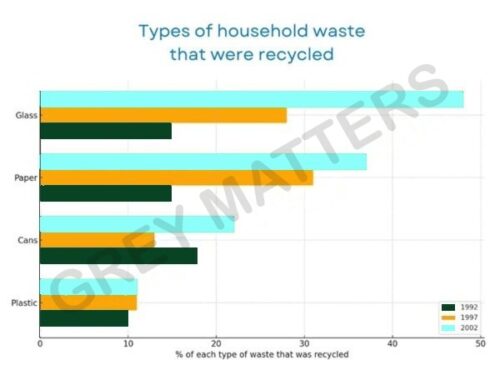
The chart below shows the percentages of different types of household waste that were recycled in one city between 1992 and 2002.
Summarise the information by selecting and reporting the main features, and make comparisons where relevant.
Write at least 150 words (You should spend 20 minutes on this task).
Sample Answer
The given bar chart presents information about the proportion of four types of domestic waste—glass, paper, cans, and plastic—that were recycled in a particular city between 1992 and 2002.
Overall, recycling rates showed an upward trend across the decade, particularly for glass and paper, which became the most recycled materials by the end of the period. On the other hand, plastic remained the least recycled waste category, with only minimal progress.
In 1992, recycling levels were relatively low for all materials. Glass and paper were both recycled at around 15%, while cans had a slightly higher figure of about 18%. Plastic was recycled the least, standing at roughly 10%.
By 1997, there was a clear rise in the recycling of glass and paper. Glass increased to nearly 28%, and paper reached approximately 30%. However, the recycling rate for cans dropped slightly to around 15%. Plastic continued to stay almost unchanged, remaining below 10%.
In 2002, glass recycling rose sharply to just under 50%, making it the highest among the four categories. Paper also climbed significantly to about 37%. Cans showed a moderate improvement, reaching around 20%, whereas plastic increased only slightly to nearly 12%.
To conclude, glass and paper experienced substantial growth in recycling, while plastic consistently had the lowest recycling rates.
WRITING TASK 2
Some people believe that entertainment, such as games available on portable electronic devices, can be harmful to individuals and society.
To what extent do you agree or disagree?
Sample Answer
Some individuals believe that entertainment activities, particularly games available on portable electronic gadgets, can have negative consequences for both people and society. I agree to some extent, as these games may cause harm if misused, although they can also provide certain benefits when enjoyed in a balanced way.
Firstly, playing games on mobile devices can be damaging to personal well-being. Many children and teenagers become overly dependent on such games and spend long periods in front of screens. This unhealthy habit may result in physical problems such as reduced fitness, eye fatigue, and irregular sleep. Additionally, excessive gaming can distract individuals from important tasks, including schoolwork and professional duties, which can lead to poor achievement.
Secondly, the widespread use of portable games may also affect society in a negative manner. People who spend too much time gaming may withdraw from real-world communication and interact less with family or friends. This can weaken social bonds and reduce involvement in community life. Moreover, certain games contain violent or inappropriate content, which could influence young players’ attitudes and behaviour.
On the other hand, portable games are not entirely harmful. They can serve as a source of relaxation and stress relief after a busy day. Some games even improve cognitive abilities such as problem-solving, quick thinking, and hand-eye coordination. Multiplayer games may also encourage teamwork and social connection online.
In conclusion, electronic games can be harmful if overused, but they may also be enjoyable and useful when played responsibly.
