



















Dubai Latest Speaking Questions – October 2025
October 6, 2025Australia Latest Speaking Questions – October 2025
November 3, 2025WRITING TASK 1
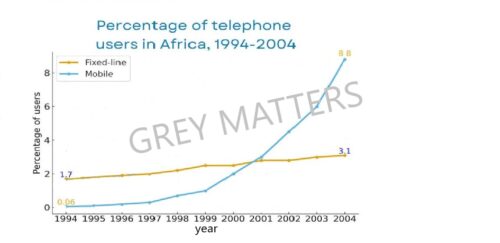
The line graph below shows the percentage of people using mobile and fixed-line phones in Africa between 1994 and 2004.
Summarise the information by selecting and reporting the main features, and make comparisons where relevant.
Write at least 150 words (You should spend 20 minutes on this task).
Write at least 150 words (You should spend 20 minutes on this task).
Sample Answer
The line graph illustrates the percentage of people in Africa using mobile and landline phones between 1994 and 2004. Overall, mobile phone usage increased dramatically over the period, whereas landline usage grew slowly and remained much lower than mobile usage throughout the decade. In 1994, approximately 2% of the population used mobile phones, compared with around 5% who used landlines. Over the next six years, mobile phone usage experienced a steady rise, reaching about 25% in 2000, while landline usage increased only slightly to just under 10%. Between 2000 and 2004, mobile phones saw a sharp surge, climbing to nearly 50%, whereas landline phones showed minimal growth, peaking at around 12%.
WRITING TASK 2
In many countries, traditional foods are being replaced by fast food. This harms families, individuals, and society.
To what extent do you agree or disagree?
Sample Answer
In recent years, fast food has become increasingly popular worldwide, gradually replacing traditional cuisines. I completely agree that this trend has detrimental effects on individuals, families, and society as a whole.
One major drawback of the growing preference for fast food is its negative impact on health. Traditional meals are generally balanced and nutritious, whereas fast foods are often high in calories, fats, and sugars. Regular consumption of such unhealthy food can lead to serious health problems, including obesity, diabetes, and heart disease.
For instance, in countries like the United States, where fast food culture is widespread, the rate of lifestyle-related illnesses has increased sharply. Moreover, the replacement of traditional foods has weakened family bonds. In the past, families used to prepare and share meals, strengthening relationships and preserving cultural values.
Nowadays, many people prefer to eat alone or buy ready-made food, resulting in reduced family interaction and the loss of culinary traditions passed down through generations. On a broader level, society is also affected. Traditional cuisine forms a crucial part of a nation’s cultural identity. As fast food chains expand, local food customs are disappearing, and global diets are becoming increasingly uniform. This trend not only threatens cultural diversity but also promotes consumerism and unhealthy eating habits.
