



















Oman Latest Speaking Questions – July 2025
July 15, 2025UK Latest Speaking Questions – July 2025
July 16, 2025WRITING TASK 1
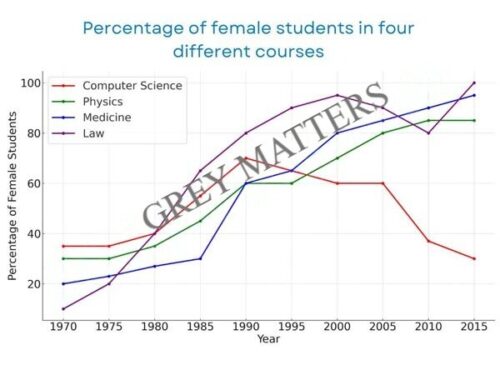
The graph below shows the proportion of female students enrolled in four university courses from 1970 to 2015.
Summarise the information by selecting and reporting the main features, and make comparisons where relevant.
Write at least 150 words (You should spend 20 minutes on this task).
Sample Answer
The graph presents data on the percentage of female students studying four different university courses—Computer Science, Physics, Medicine, and Law—from 1970 to 2015. In general, there was a steady rise in the number of women in all subjects up until around 2000. After this point, most fields either stayed the same or continued to grow, except for Computer Science, which saw a drop. In 1970, Law had the smallest number of female students (around 10%), while Computer Science and Physics were close to 35%. Medicine had a slightly lower figure, about 20%. Between 1970 and 2000, the percentage of women in each subject grew. Law and Medicine reached close to 90% by the year 2000. After 2000, female enrollment in Computer Science fell sharply, going down to 30% by 2015. In contrast, Law increased and reached 100%. Medicine and Physics also stayed strong, both above 85% in 2015. To sum up, Law and Medicine became the top choices for female students, while Computer Science saw a fall in interest after 2000.
WRITING TASK 2
In some cultures, older people are highly respected, whereas others value youth more.
Discuss both views and give your opinion.
Give reasons for your answer and include relevant examples from your knowledge or experience.
Sample Answer
Different cultures have different beliefs about age. In some places, older people are given a lot of importance, while in others, young people are considered more valuable. Both opinions have valid reasons. This essay will look at both sides and share my personal view.
In many traditional societies, older people are honored because they have lived longer and gained more wisdom. They are trusted to give good advice and help with important choices. For example, in countries like India and Japan, elders often lead the family and are respected by all. They also help keep traditions and culture strong.
However, in some modern countries, youth is seen as more important. Young people are active, creative, and good with new technology. They often bring fresh ideas and help bring change to the world. For instance, companies like Facebook and Tesla were started by young people. In these cultures, people believe that talent and intelligence matter more than age.
I believe that both age groups are important. Older people have useful experience and can guide others. Young people have energy and new ways of thinking. If both work together, the community will benefit.
In conclusion, while some cultures respect older people and others focus more on the young, I think every age group has value. A good society should respect and support both, as each group has something different and helpful to offer.
