

















Italy Latest Speaking Questions – July 2025
July 22, 2025Canada Latest Speaking Questions – July 2025
July 26, 2025WRITING TASK 1
The chart below shows the percentages of different types of household waste that were recycled in one city between 1992 and 2002.
Summarise the information by selecting and reporting the main features, and make comparisons where relevant.
Write at least 150 words (You should spend 20 minutes on this task).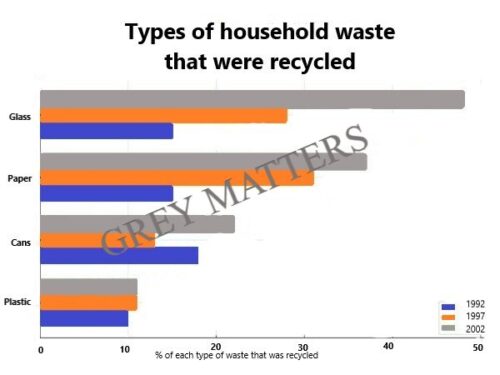
Sample Answer
The bar chart shows the percentage of four types of household waste—glass, paper, cans, and plastic—that were recycled in one city in the years 1992, 1997, and 2002. Overall, the recycling rate increased for all waste types during this period. Glass and paper were recycled the most, while plastic remained the least recycled item. In 1992, around 24% of glass waste was recycled. This percentage rose steadily to about 38% in 1997 and reached nearly 50% in 2002. Paper recycling also improved over the years, starting at about 20% in 1992 and increasing to 45% by 2002. Cans had a lower recycling rate at first, but it increased from nearly 15% in 1992 to over 30% in 2002. Plastic had the lowest recycling rate throughout the period. It started at just 7% in 1992 and slightly increased to around 12% by 2002. In conclusion, recycling became more common, especially for glass and paper.
WRITING TASK 2
Some people think history has little to teach us, but others think that studying the past can help us better understand the present and predict the future.
Discuss both views and give your own opinion.
Give reasons for your answer and include relevant examples from your knowledge or experience.
Sample Answer
Some people believe that history is not very useful and has little to teach us. They believe that learning about the past is a waste of time, as we should focus on the present and the future. They say that old events do not help solve modern problems. However, others believe that history is very important. It helps us understand how the world has changed and why things are the way they are today. By studying past mistakes, we can learn how to avoid them in the future. For example, learning about world wars teaches us the importance of peace and international cooperation. History also helps us understand different cultures, traditions, and values. In my opinion, history is very useful. It teaches us important lessons and helps us make better decisions. Without knowledge of history, we may repeat the same mistakes. So, studying history can help us live better in the present and plan wisely for the future.
